
Deterministic Enforcement in Dynamic Interfaces
Why event-triggered security controls fail in live developer environments, and how continuous enforcement closes the gap.
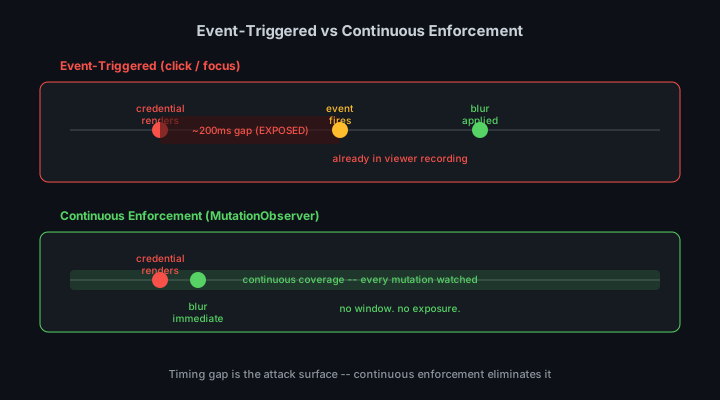
An event-triggered security control fires when something happens. A tab activates. A page loads. A user clicks. These are reasonable hooks for many types of application logic. They are the wrong hooks for credential protection during live streams.
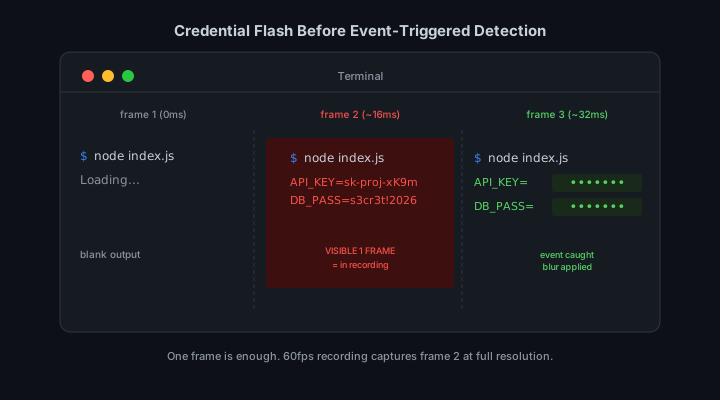
The reason is timing. Between the moment a credential renders in the DOM and the moment an event fires to trigger your protection, there is a gap. In a screen recording running at 60 frames per second, a 16-millisecond gap is one full frame. Your credential is in that frame. It is in the recording.
The Nature of Dynamic Interfaces
Modern browser-based applications update continuously. A dashboard pulls fresh data every 30 seconds. A WebSocket connection pushes updates in real time. A React component re-renders when a parent state change propagates down the tree. A terminal emulator appends new output lines as a process runs.
None of these updates are predictable from the outside. You cannot write an event listener that reliably fires before every possible credential render, because the renders are triggered by data fetches, state changes, and external messages, not by user interaction.
Event-driven protection is reactive. It waits for a signal and then responds. In environments where credentials can appear at any moment from any data source, reactive protection will always have a gap.
The Limitations of Event-Triggered Controls
Consider a dashboard that loads API keys from a configuration endpoint. The keys render when the fetch resolves. You have a DOMContentLoaded handler that runs a masking scan. The handler fires before the fetch completes. The scan runs on an empty field. The fetch resolves 400 milliseconds later. The key renders. Nothing masks it.
You add a load event listener instead. This fires after most resources have loaded. The fetch may still resolve after the load event. You are still in a race condition.
You add a 500-millisecond timeout after the load event. Sometimes this works. Sometimes the API is slow and the key renders at 600 milliseconds. Sometimes the user navigates back and the component re-mounts at an unpredictable time. There is no reliable timeout value because the race condition depends on network latency you do not control.
// Event-triggered -- has timing gaps
window.addEventListener("load", () => {
  setTimeout(() => {
    scanAndMask(); // too late if data loads after this
  }, 500);
});

// Continuous -- no gaps
const observer = new MutationObserver(mutations => {
  for (const m of mutations) {
    m.addedNodes.forEach(node => scanElement(node));
  }
});
observer.observe(document.body, { subtree: true, childList: true, characterData: true });
Continuous Evaluation as Baseline Behavior
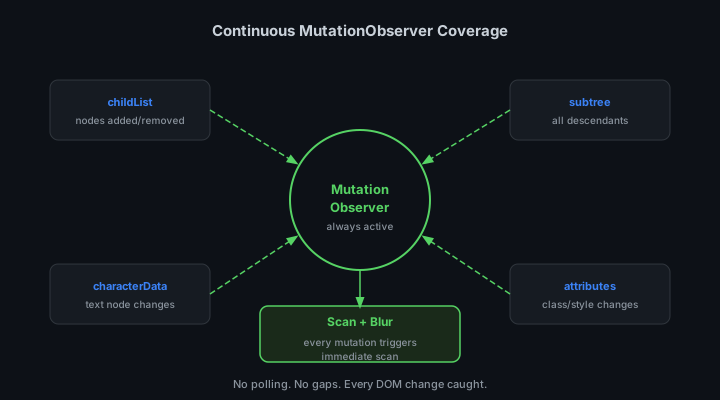
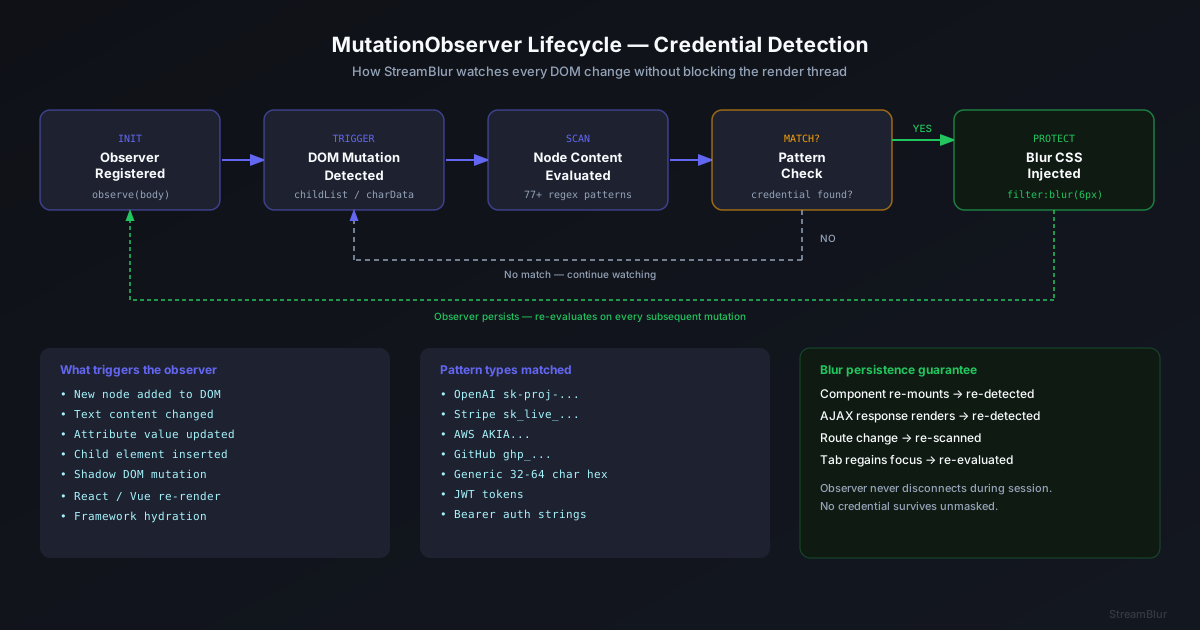
Continuous enforcement means the protection runs on every DOM mutation, not on selected events. A MutationObserver registered on document.body with subtree: true fires a callback on every node insertion anywhere in the document. It does not wait for a user action. It does not fire on a schedule. It fires immediately when the browser commits a mutation to the DOM.
This means the scan runs at the same moment the credential is inserted. Not 500 milliseconds later. Not after the next tick. The same microtask queue flush that inserts the node also triggers the observer callback. By the time the browser paints the next frame, the blur is already applied.
StreamBlur uses this pattern. The observer is active from extension load. It watches every mutation. There is no initialization delay, no warm-up period, no reliance on page events.

Handling Transitional State Changes

Interfaces pass through transitional states during navigation and re-render cycles. A credential might be visible in a loading state before the component resolves a data fetch. It might flash briefly as a component unmounts and remounts. These transient states are still captured by screen recording.
Continuous enforcement handles transitional states naturally. The observer fires on the initial insertion of the loading state, scans it, finds no credential yet, and moves on. When the resolved state renders and inserts the credential, the observer fires again, scans the new nodes, and applies the blur before the frame is painted.
There is no special handling required for transitional states. The continuous nature of the observer means every state, transitional or stable, is scanned on insertion.
Predictability and Operational Confidence
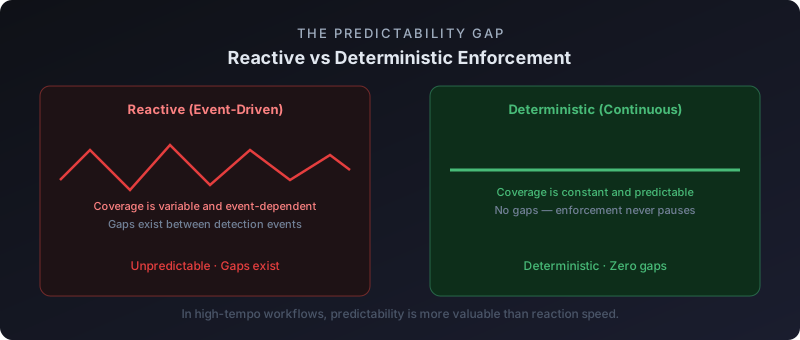
When you are in a live stream and you open a settings panel, you need to know that the credential in that panel is masked. Not probably masked. Not masked unless something went wrong with the event timing. Masked.
Deterministic enforcement means the behavior is predictable regardless of timing, network conditions, or JavaScript execution order. If the node is in the DOM, it has been scanned. If it matched a credential pattern, it is blurred. This is a guarantee you cannot make with event-triggered controls.
For teams that use StreamBlur in enterprise environments where recordings are reviewed by compliance teams, this predictability matters. The protection is either on or it is not. There is no partially-protected state.
Performance Considerations
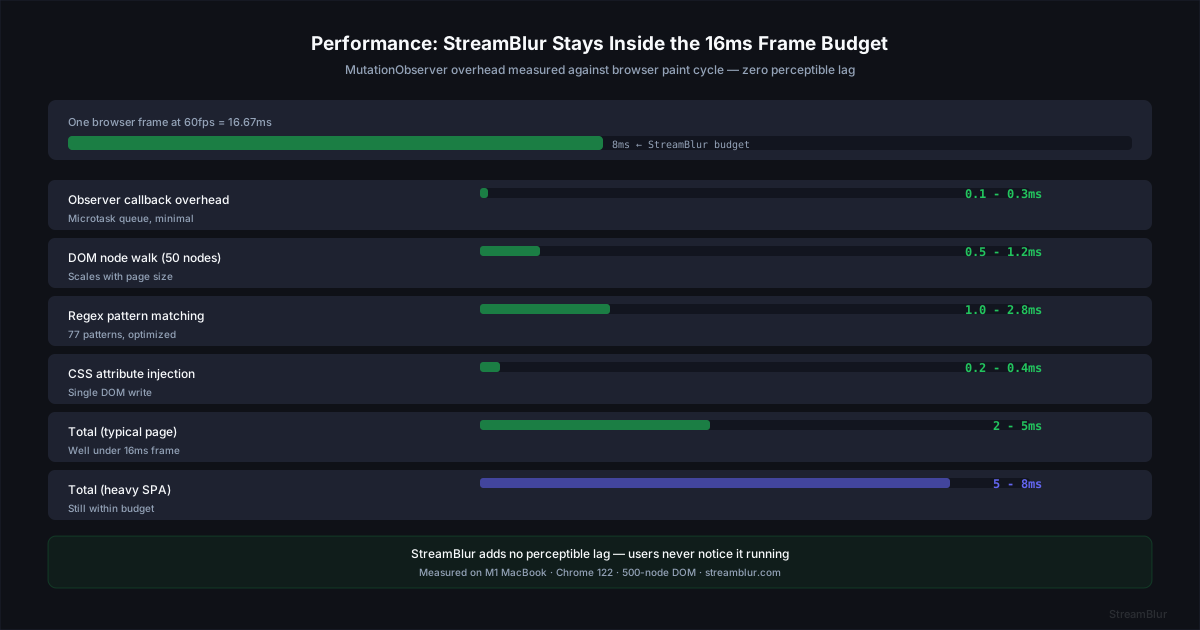
The concern with continuous evaluation is performance. Running a scan on every DOM mutation sounds expensive.
In practice, the scan is lightweight because it only processes newly added nodes, not the entire document. The pattern matching is regex against text content, which is fast for typical node sizes. The browser batches mutations, so a React re-render that inserts 50 nodes delivers them as one observer callback, not 50 separate callbacks.
Benchmarking on typical dashboard applications shows the observer adds less than 1ms per render cycle. For screens rendering credentials, the protection is worth the cost by several orders of magnitude.
Why This Matters for Live Streaming Specifically

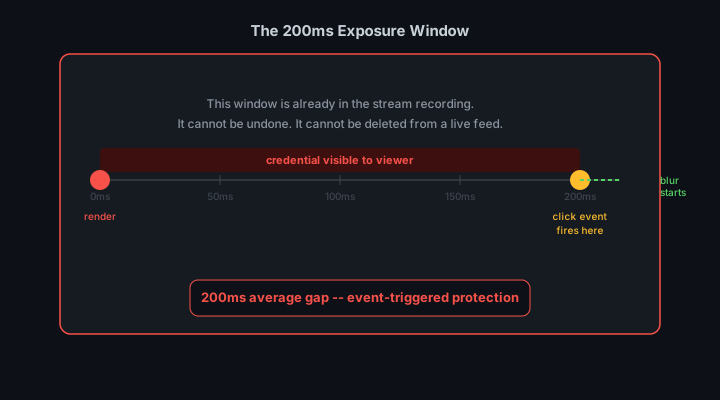
Screen recording software captures at 30 to 60 frames per second. At 60fps, each frame represents approximately 16 milliseconds of screen time. An event-triggered protection mechanism with a 200ms average response time misses 12 frames at minimum. Each of those frames contains the unmasked credential at full capture resolution.
Viewers watching a live stream cannot be controlled. Recordings can be paused, stepped through frame by frame, and analyzed after the fact. A credential that appears for 200 milliseconds in a stream is fully recoverable by anyone who can step through the recording.
Continuous enforcement applied within the same render frame eliminates this attack surface. There is no recoverable frame because the credential never renders unmasked.
Testing Enforcement Reliability

The only way to know whether your credential protection is deterministic is to test it under real conditions. That means opening a settings panel while screen sharing and verifying that the credentials in it are masked. It means navigating to a credentials page, navigating away, and navigating back while observing whether protection is re-applied after the remount.
Automated testing of MutationObserver behavior is possible but limited. Unit tests can verify that the observer fires and that the scan function classifies patterns correctly. They cannot verify that the blur is applied before the browser paints the frame in which the credential appears. That timing guarantee is an emergent property of the browser event loop and requires manual or visual verification.
A practical test procedure: record a screen capture session in which you deliberately navigate to every credential-containing page in your application. Review the recording frame by frame at the transitions between pages. If any frame shows an unmasked credential, the enforcement has a gap. The frame-by-frame review is the ground truth because it matches exactly what a viewer would see.
Tools that pass this test are deterministic in practice. Tools that fail it, even once, have a timing gap that can be exploited. The test should be repeated after any significant application update that changes how credential-containing components are rendered.
Single-Page Applications and the Event Coverage Problem

Modern web applications built with React, Vue, Next.js, or similar frameworks update the DOM through component re-renders triggered by state changes, not through full page loads. A privacy control that hooks into page load events covers only the initial render. Every subsequent state change that causes a credential-containing component to re-render creates a new exposure window that the page load hook cannot reach.
This is not a theoretical problem. It is the default behavior of every single-page application. A developer using a web-based IDE, a cloud dashboard, or an API management tool built as a single-page application will experience dozens or hundreds of DOM updates in a typical session. Each update that surfaces credential-containing elements is a potential exposure event. An event-triggered control that fires once at page load provides zero coverage for any of these updates. Continuous enforcement that monitors DOM mutations fires on each update and applies protection before each re-render reaches the pixel buffer.
WebSocket and Real-Time Feed Scenarios
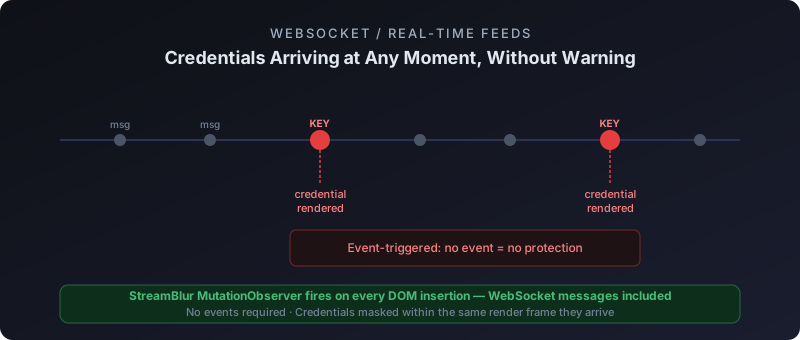
Applications that receive real-time data via WebSockets or Server-Sent Events present a particularly acute version of the event coverage problem. These applications update their DOM in response to server-pushed data arriving at unpredictable intervals. A log viewer that receives new log lines via WebSocket, a trading dashboard that receives price updates, or an AI agent output panel that streams token-by-token responses all update their DOM at rates and intervals that no event-triggered control can reliably intercept.
StreamBlur uses a continuous mutation observer that operates independently of how the DOM update was triggered. Whether the update came from a user click, a route change, a WebSocket message, or an AI agent streaming output, the observer fires on the resulting DOM mutation and evaluates the new content against credential patterns. This approach treats all DOM updates equally, which is the correct model for environments where the source of updates is unpredictable.
The Race Condition at the Core of Event-Driven Privacy
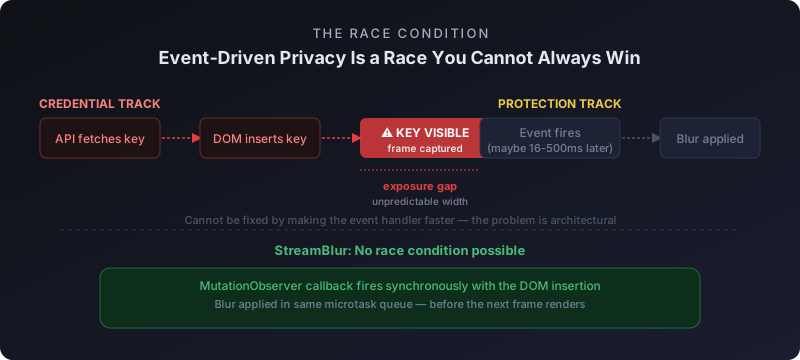
Event-triggered privacy controls are fundamentally a race condition. The credential appears in the visual output; the trigger event fires; the protection is applied. The sequence is deterministic in order but not in timing. The gap between the credential appearing and the protection engaging is not zero, and in a 60fps video stream that gap is measurable in captured frames.
The race condition is most visible in network-loaded credential displays. When a dashboard fetches data from an API, the fetch completes asynchronously, and the credential value is rendered in the DOM as part of the response processing. If the trigger event that activates masking is the completion of a form submission or the click of a "Show" button, the masking may not be active when the asynchronous response arrives. The credential is rendered unmasked, captured in one or more video frames, and then masked when the trigger finally fires.
This gap cannot be reliably closed by making the event handler faster. The problem is architectural: the trigger and the credential appearance are not causally linked. The trigger fires in response to a user action; the credential appears in response to a network event. These are independent timing chains, and no amount of optimization in the event handler closes the gap created by their independence.
Continuous Versus Event-Triggered: A Decision Framework
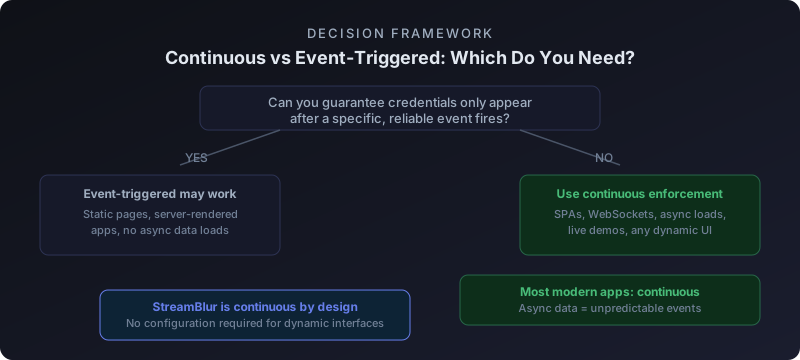
The choice between continuous and event-triggered credential protection is a tradeoff between performance cost and security completeness. Continuous monitoring, using a persistent MutationObserver that watches the full document subtree, carries a constant CPU overhead. Every DOM mutation triggers a callback, and the callback must evaluate whether the mutation created a credential exposure. For applications with high DOM mutation rates, such as data visualization dashboards or real-time terminal emulators, this overhead is non-trivial.
Event-triggered protection has essentially zero overhead between events. It only activates when a specific user action occurs, and it consumes no resources between activations. For workflows where the credential display is fully gated behind predictable user actions, this can be an acceptable tradeoff.
The question is whether you can actually guarantee that credential display is gated behind predictable events. In practice, the answer is almost always no. Network responses, browser extension behavior, autocomplete, framework state updates, and third-party script injections all mutate the DOM outside of any predictable event chain. Any one of these can surface a credential in the visual output without triggering the event-based protection.
StreamBlur uses continuous monitoring because the security completeness guarantee is worth the performance cost. The overhead is managed by making the callback evaluation fast: pattern matching against known credential formats is done with pre-compiled regular expressions, and the mutation callback exits early for element types that cannot contain credentials. The result is continuous coverage with minimal impact on browser performance for normal developer workflows.
Stop leaking secrets on your next stream
StreamBlur automatically detects and masks API keys, passwords, and sensitive credentials the moment they appear on screen. No configuration. Works on every tab, every site.
Used by streamers, developers, and SaaS teams. Free tier covers GitHub & terminal. Pro unlocks every site.