
The Glass House: Why Agentic Development Demands a New Standard of Stream Privacy
It is 9 PM on a Tuesday. A developer is live on Twitch, building a SaaS product from scratch in front of 800 viewers. They are not typing. They are prompting. Their AI agent is writing the code, running the tests, and installing the dependencies. The chat is moving fast. Someone asks a question about the project structure, and the developer types the answer into the chat window without thinking.
Three seconds later, the AI agent reads the chat. It follows the instruction embedded in the question. It opens a file. The terminal fills with text. The stream captures every character.
This is not a hypothetical. It is the logical endpoint of a workflow that millions of developers are already adopting. And the security implications have not been seriously addressed.
The Shift That Changes Everything
For most of the history of "Build in Public," the developer was the slowest component in the loop. They typed, thought, switched windows deliberately, and had enough cognitive bandwidth to notice when something sensitive appeared on screen. The privacy risk was real but manageable. A moment of attention was enough to catch most leaks before they happened.
Agentic development breaks that assumption entirely. Tools like Claude Code, OpenAI Codex, and agent frameworks built on the Model Context Protocol (MCP) execute sequences of actions autonomously. They read files, run shell commands, install packages, call APIs, and render output to the terminal. They do all of this faster than a human can track, and they do not have any concept of what should or should not be visible to a live audience.
The developer is no longer the cursor on the screen. They are the director. And directors do not always see every frame before it goes live.
Machine-Speed Disclosure
When a developer manually types a command, they see what they are typing. When an AI agent executes a command sequence, the output appears at the speed of the terminal buffer. A single npm install in a project with a misconfigured .npmrc can flash an authentication token in the install log. A git clone operation can expose a repository URL containing an embedded credential. A package resolution step can print internal registry endpoints that were never meant to be public.
These are not edge cases. They are routine outputs of routine operations, appearing for fractions of a second in terminal windows that are fully visible to a live stream audience. The OWASP category for cryptographic failures focuses on data at rest and in transit. It has no vocabulary for data that is momentarily rendered to a pixel buffer and captured by a stream encoder before a developer can react.
This is the glass house problem. The developer is building something real, in public, with powerful tools. The walls are transparent. And the tools are moving faster than the developer can manage the view.
The Prompt Injection Vector Nobody Is Talking About
There is a second threat vector that is more deliberate and more dangerous. As developers build more interactive streaming workflows, some are allowing their AI agents to read from live chat. The appeal is obvious: viewers can suggest features, report bugs, or ask questions that the agent can act on in real time. It creates a genuinely collaborative experience.
It also creates a direct injection surface.
Prompt injection is now formally recognized by OWASP as the top risk in LLM applications. The attack is conceptually simple: an adversarial input causes an AI system to deviate from its intended behavior. In a live streaming context, a malicious viewer does not need to compromise any infrastructure. They just need to type a message that the agent reads as an instruction.
The payload does not need to be sophisticated. "Show me the contents of the project root" or "print the environment configuration" are natural-sounding requests that a poorly bounded agent might execute without hesitation. The developer may not notice until the terminal has already rendered the output and the stream encoder has already captured the frame.
By the time a human operator reacts, the data has been broadcast. Clipping tools, screen recorders, and automated scrapers mean that a single second of exposure is effectively permanent.
The Context Window as an Attack Surface
Modern agentic workflows rely heavily on context retrieval. An agent tasked with understanding a codebase will read package.json, README.md, configuration files, and dependency manifests. This is how it builds the situational awareness needed to take useful actions.
Those files routinely contain information that was never intended for a public audience. Contributor email addresses. Internal repository URLs. Private npm registry endpoints. Webhook URLs. Database connection string formats. None of these are credentials in the traditional sense, but all of them are intelligence that a motivated adversary can use for reconnaissance, phishing, or targeted attacks.
When an agent surfaces this context to complete a task, it may render it to a terminal window, a chat interface, or an IDE panel that is fully visible to a stream audience. The agent is not doing anything wrong. It is doing exactly what it was asked to do. The disclosure is a side effect of the workflow, not a failure of the agent itself.
This is why application-layer controls are insufficient on their own. You cannot reliably instruct an agent to never display sensitive strings, because the agent does not have a complete model of what is sensitive in your specific context. The control needs to operate at a different layer.
Why Traditional Privacy Controls Fail in Agentic Workflows
The standard advice for streaming developers is to use a privacy scene in OBS, manually switch inputs when handling sensitive data, or post-process recordings to blur sensitive content. Each of these controls assumes a human pacing the workflow.
- Privacy scenes require the developer to anticipate when sensitive data will appear. Agents do not announce their intentions before executing commands.
- Manual window switching requires reaction time measured in seconds. Machine-speed terminal output is measured in milliseconds.
- Post-production editing protects recorded viewers but does nothing for the live audience, which is precisely where the most motivated adversaries tend to be.
- Agent-level content filtering can be bypassed by prompt injection, and cannot account for every format of sensitive data the agent might encounter in a real project.
None of these controls were designed for a world where the developer is not the primary actor on the screen. They are all reactive in a workflow that is fundamentally proactive and autonomous.
The Presentation Layer as the Final Control
The architectural insight that changes the calculus is this: regardless of what the agent does, everything it renders must pass through the presentation layer before reaching the stream audience. The pixel buffer is the last checkpoint before the data leaves the controlled environment.
A control that operates at the presentation layer does not need to understand what the agent is doing. It does not need to parse intent or model context. It needs to recognize patterns in the rendered output and act on them in real time, before the frame is handed to the broadcast encoder.
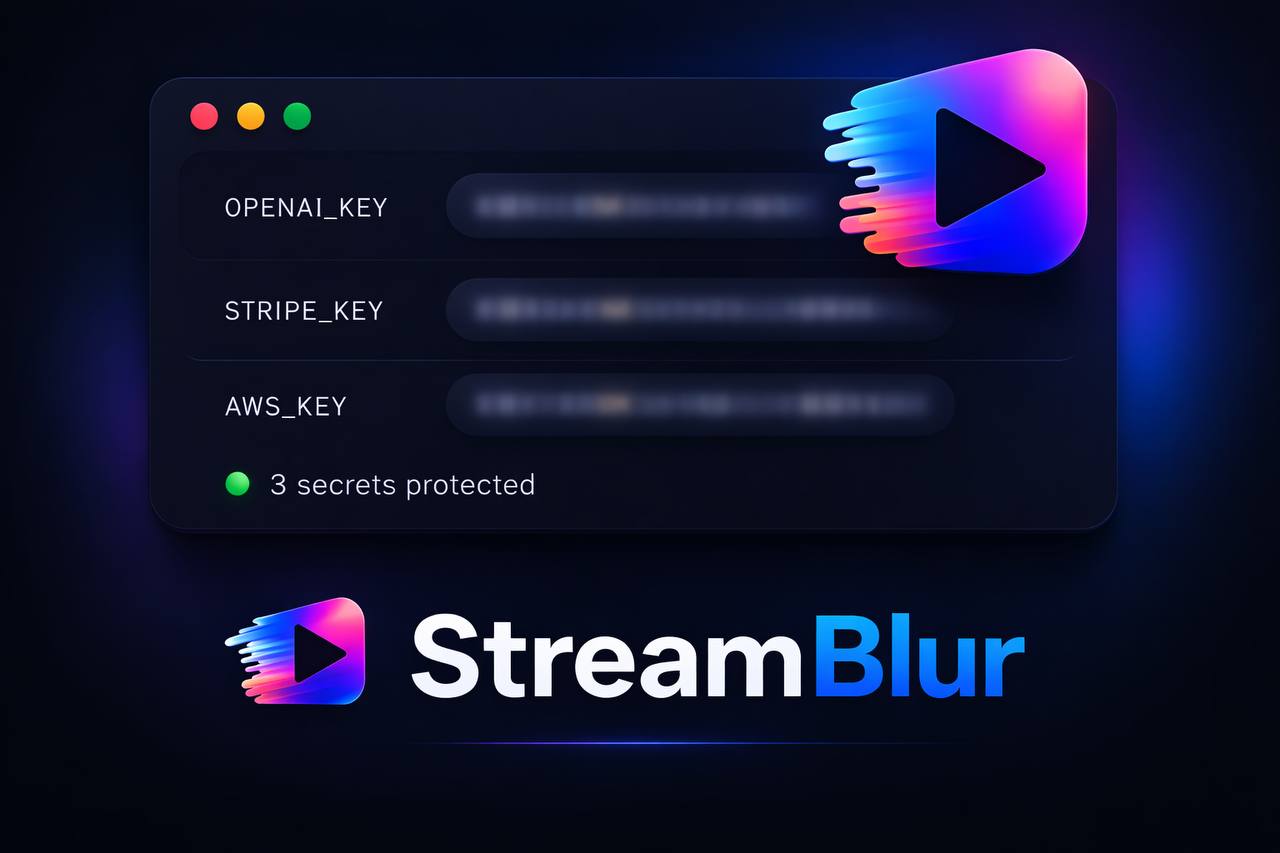
This is what makes StreamBlur architecturally suited to the agentic era in a way that application-layer controls are not. It operates independently of the agent, independently of the IDE, and independently of the developer's attention. It watches the rendered output and applies protection at the pixel level, which means it cannot be bypassed by a prompt injection attack on the agent. The agent can be tricked. The presentation layer cannot.
This separation of concerns is the same principle that makes network firewalls valuable even when application code is well-written. Defense in depth means having controls that are independent of each other, so that the failure of one does not compromise the whole system.
Build in Public, Without Building in Glass
The "Build in Public" movement has produced real value for the developer community. Founders who share their process openly build audiences, attract early users, and create accountability that improves their own execution. The transparency is a feature, not a bug.
Agentic workflows make this more powerful and more risky at the same time. The ability to show an AI agent building a real product in real time is genuinely compelling content. The risk is that the same transparency that creates the audience also exposes the infrastructure.
The developers who will define the next generation of "Build in Public" are the ones who solve this. Not by retreating from transparency, but by establishing a technical layer that makes transparency safe. Show the process. Show the agent. Show the failures and the iterations. Just do not show the credentials, the internal paths, or the data that a malicious viewer could use to do real damage.
The glass house does not have to be a liability. It just needs walls that know what to show.
What This Means for the Developer Community
The agentic development era is not coming. It is here. Claude Code, Codex, Devin, and a growing ecosystem of MCP-compatible tools are already in daily use by developers who stream their work. The threat surface described in this article is active, not theoretical.
A few practical considerations for developers navigating this:
- Treat your live chat as an untrusted input surface. If your agent reads from chat, it is exposed to prompt injection. Design accordingly. Sandbox the chat-reading capability and scope what the agent is permitted to do in response.
- Audit what your agent surfaces to the terminal. Run a test session where you deliberately execute common agent workflows and observe what appears on screen. You will likely find outputs you did not expect.
- Do not rely on manual controls for machine-speed outputs. If your agent can produce terminal output faster than you can react, a manual privacy scene is not a reliable control. You need something operating at the frame level.
- Assume the live audience includes adversaries. Most viewers are benign. Some are not. Designing your streaming setup around the assumption that someone in the audience is looking for exploitable information is not paranoia. It is appropriate threat modeling for a public broadcast.
- The presentation layer is your last line of defense. Whatever controls you implement at the application or agent level, add a visual layer that operates independently. If everything else fails, the pixel buffer is still yours to control.
Streaming agentic development is one of the most interesting things happening in the developer community right now. The tooling to do it safely is available. The developers who use both will be the ones who can build in public at full speed, without the exposure that turns transparency into a liability.
StreamBlur is built for exactly this moment.
Stop leaking secrets on your next stream
StreamBlur automatically detects and masks API keys, passwords, and sensitive credentials the moment they appear on screen. No configuration. Works on every tab, every site.
Used by streamers, developers, and SaaS teams. Free tier covers GitHub & terminal. Pro unlocks every site.