
Turning Expertise Into Products Without Breaking Your Workflow
Turning expertise into products without breaking your workflow
Developers spend years building deep expertise in specific domains. You understand deployment pipelines, you know how authentication systems fail, you have mental models for debugging race conditions. That expertise is valuable. The question is not whether you should turn it into a product. The question is how to do it without abandoning the work that built the expertise in the first place.
Most advice on building products assumes you have unlimited time, a co-founder, or venture funding. None of that applies to developers who are shipping production code during the day and building products at night. The constraint is real. The solution is not to work more hours. It is to extract products directly from your existing workflow.
This guide is based on building StreamBlur while working full-time as a developer. Every principle comes from shipping a product that people pay for, without quitting a day job or raising capital. What follows is the process that worked.
Finding Product Ideas in Pain Points You Already Solved
The best product ideas come from problems you have already solved for yourself. Not problems you think other people have. Not trends you read about on Twitter. Problems you encountered, got frustrated by, and built a solution for because no existing tool worked.
StreamBlur came from accidentally exposing an API key during a client demo. The existing solutions were manual region blurring in OBS or remembering to close tabs. Both required attention at the exact moment when attention was focused on the demo. The product idea was not "build a credential masking tool." It was "automate the thing I keep forgetting to do manually."
Look for pain points that meet three criteria: you encounter them repeatedly, existing solutions require manual intervention, and other developers in your network have the same problem. If you have built a workaround script or written internal documentation about it, that is a product signal.
- Repetitive tasks you solve manually every day
- Questions teammates ask you repeatedly
- Tools you wish existed but don't
- Workflows you've scripted or automated privately
- Problems you Google frequently with no good answer
The advantage of building from your own pain is that you are also the first customer. You know whether the solution works because you use it every day. You know which features matter because you feel the friction when they are missing. Customer discovery is built into your existing workflow.
Validation Without Quitting Your Job
Validation does not require months of user research or expensive market analysis. The fastest way to validate demand is to put something in front of potential customers and measure their response. This can happen in days, not months.
Start by writing a single tweet explaining the problem you solved and how your solution works. Include a call to action: "Reply if you want early access" or "DM me if this sounds useful." The quality and volume of responses will tell you immediately whether people care about this problem.
If you get 10-20 interested replies within 48 hours, you have validated demand. If you get crickets, the problem may not be as widespread as you thought, or your explanation did not resonate. Either way, you learned something critical without building anything.
Validation does not require months of user interviews. It requires showing something real to people who have the problem and watching what they do. The goal is not to ask "Would you use this?" The goal is to put a working version in front of them and observe whether they actually use it.
- Build a minimal version in 1-2 days (weekends count)
- Share it with 5-10 people in your network who have the problem
- Ask "Would you pay $X for this?" and watch their reaction
- Track actual usage, not stated interest
- Iterate based on what breaks, not what people say they want
For StreamBlur, validation was sending a Chrome extension to ten developers who streamed on Twitch. Three of them installed it immediately. Two asked how much it cost. That was enough signal to keep building. The validation cost zero dollars and two days of work.
If no one installs it when it is free, they will not pay for it when it costs money. If people install it but never open it again, the problem is not painful enough to justify a product. Validation is not about collecting compliments. It is about identifying whether usage happens without you prompting it.
Building Without Breaking Your Workflow
The constraint is time. You have a job that pays the bills. You have responsibilities that do not pause while you build a product. The approach that works is not "find more time." It is "extract product work from existing time."
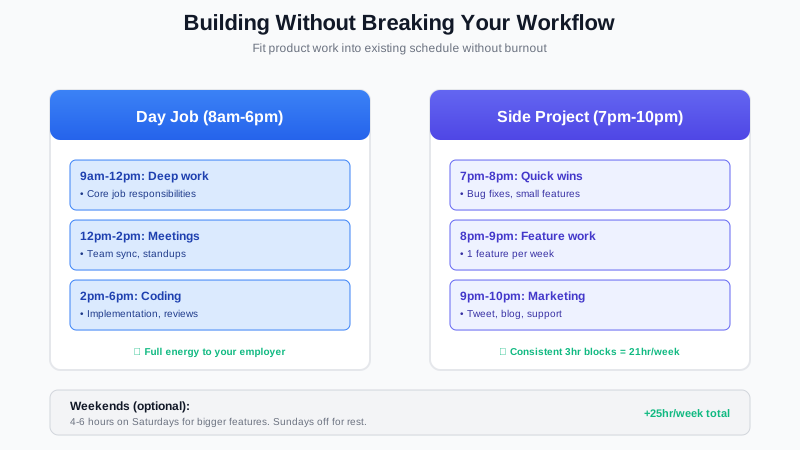
- Build during existing downtime (commute, lunch breaks, weekends)
- Use tools and frameworks you already know (no learning curves)
- Ship imperfect MVPs instead of polished products
- Automate marketing with scheduled posts and email sequences
- Set strict scope limits: one feature, one week maximum
The first version of StreamBlur was 400 lines of JavaScript and a MutationObserver. It did one thing: blur credentials in the browser. No dashboard. No analytics. No settings panel. Just the core value. That version shipped in three days and made the first sale within a week.
Scope discipline is the difference between shipping and abandoning projects. Every feature you add before launch is a feature that delays revenue. Every settings toggle is a maintenance burden. The correct approach is to ship the smallest version that solves the problem, then add features based on what paying customers actually request.
Use your day job as a testing ground. If you are building a deployment tool, use it for your team's deploys. If you are building a monitoring dashboard, point it at your production systems. This approach gives you real usage data without needing to recruit beta users. Your product gets better because you are forced to use it under real conditions.
Distribution Channels That Work for Developers
Distribution matters more than product quality in the first 90 days. A mediocre product with strong distribution will outperform an excellent product with no distribution every time. Focus on channels where your target users already gather.
For developer tools, the most effective channels are: Twitter (for initial buzz and early adopters), Hacker News (for visibility among technical decision-makers), Reddit communities like r/webdev and r/programming (for feedback and organic growth), and Product Hunt (for coordinated launch momentum). Email newsletters work well for B2B SaaS targeting specific industries.
The mistake most builders make is treating distribution as an afterthought. Plan your distribution strategy before you finish building. Identify where your first 100 customers will come from, and start engaging in those communities weeks before launch. When you ship, you should already have relationships and credibility in the places where your customers hang out.
Distribution is not optional. A great product with no distribution makes zero revenue. The good news is that developer products have well-defined channels. The challenge is not finding where developers are. It is showing up with something worth their attention.
- Twitter/X: Share the problem + solution in a thread with screenshots
- Reddit: Post in niche subreddits (/r/webdev, /r/devops), avoid /r/SideProject
- Hacker News: Show HN posts on weekends, focus on technical depth
- Product Hunt: Launch on Tuesday-Thursday for maximum visibility
- Dev.to / Hashnode: Write case studies showing how you built it
- Your network: DM 10 people who have the exact problem
The pattern that works is: problem statement, technical solution, live demos, call to action. Do not lead with features. Lead with the pain point. Developers care about whether you understand the problem. Features are table stakes. The differentiation is in how well you articulate why existing solutions fail.
StreamBlur launched with a Hacker News post titled "I accidentally leaked an API key during a demo." The post did not describe features. It described the panic of realizing a credential was visible on a recorded call and the manual workarounds that do not work under pressure. That post drove 200 signups in 24 hours because it resonated with people who had lived through the same incident.
Pricing Strategy for Technical Products
Pricing is a positioning decision, not just a revenue decision. The price you charge tells customers how valuable your product is and who it is for. Developers tend to underprice their products because they focus on cost rather than value delivered.
If your product saves a developer 10 hours per month, and their hourly rate is $100, you are delivering $1,000 of value. Charging $50/month is defensible and leaves plenty of margin for the customer. Do not charge $5/month because that is what feels comfortable to you as a developer.
Start with simple pricing: one tier, one price, clear value proposition. You can always add complexity later based on customer feedback. Avoid free tiers initially unless your product has strong viral growth mechanics. Free tiers attract tire-kickers who consume support time without contributing revenue. Charge from day one, even if the product is not perfect yet.
Pricing is not about covering costs. It is about anchoring value. A product that saves ten hours of manual work per month is worth more than $10. The mistake most developers make is underpricing because they feel uncomfortable charging for software.
- One-time payment > subscriptions for small tools (lower friction)
- Start high ($29-99), discount later if needed
- Offer a free tier to drive word-of-mouth growth
- Price based on value delivered, not hours spent building
- Test pricing with "Pay what you want" launches to find the ceiling
Start with a price point that reflects value, not cost. A tool that prevents credential leaks during live streams is worth more than a coffee subscription. The price should match the problem severity and time saved, not what feels comfortable to charge.
If you are unsure about pricing, ask five potential customers what they would pay. Then double it. The number they give you is anchored to their expectations of indie hacker pricing, not the actual value delivered. A tool that prevents one credential leak is worth more than $50. Price accordingly.
Common Mistakes That Kill Side Projects
The most common mistake is building in isolation for months without talking to potential customers. You convince yourself that the product needs to be perfect before you show it to anyone. By the time you launch, you have built features no one asked for and missed the features people actually need.
Another fatal mistake is treating your side project like your day job. At work, you have the luxury of long planning cycles, thorough QA, and extensive documentation. Side projects demand speed and focus. Ship incomplete features. Launch with bugs. Iterate in public. The feedback loop is more valuable than perfection.
Finally, many developers give up too early. They launch, get a few customers, hit a plateau, and assume the product failed. In reality, most successful side projects take 12-18 months to gain meaningful traction. Growth compounds slowly at first, then accelerates. If you quit at month 6, you miss the inflection point that happens at month 12.
Most side projects fail not because the idea was bad but because the execution violated basic principles. These are the patterns that consistently lead to abandonment.
- Building for months before getting feedback: Ship an MVP in two weeks, then iterate based on real usage
- Solving problems you don't have: If you are not the target user, validation becomes exponentially harder
- Optimizing features no one asked for: Perfect code is wasted effort if the product does not ship
- Waiting for perfection before launching: Imperfect launches generate revenue. Perfect products stay in development forever
- Ignoring marketing until after the product is done: Build an audience while you build the product
The pattern that works is: build in public, ship early, charge money from day one. If you are not embarrassed by your first version, you shipped too late. The goal is not to build a perfect product. The goal is to learn whether people will pay for a solution to the problem you identified.
Turning One Product Into Sustainable Income
One product will not replace your salary. But one product that generates $500/month is proof that the model works. The path from $500 to $5,000 is not ten times harder. It is the same process applied to more problems.
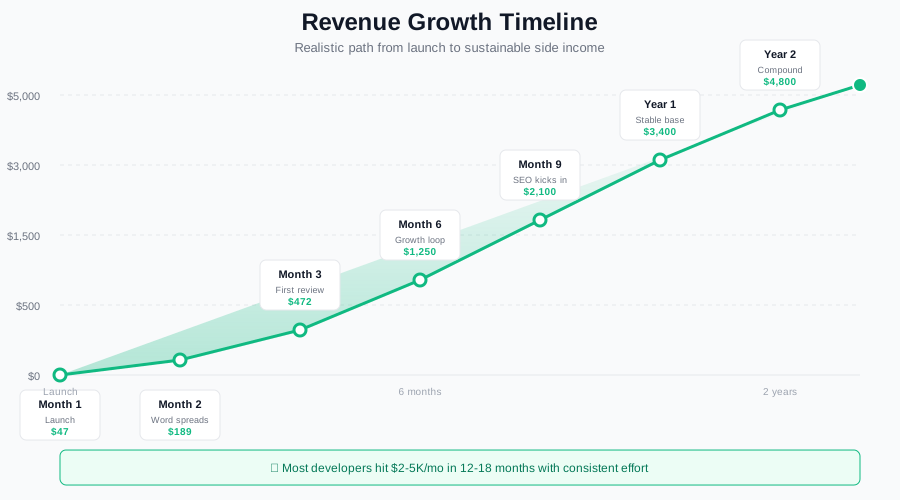
After your first product reaches consistent monthly revenue, the question becomes: scale it or build another? Both approaches work. Scaling means adding features, expanding to adjacent markets, or building enterprise tiers. Building another means applying the same playbook to a different pain point.
The compounding effect of multiple small products is underrated. Three products earning $500/month each is $1,500/month. That is meaningful income without needing any single product to achieve viral scale. The strategy is not to build one massive product. It is to build a portfolio of small, focused tools that solve real problems.
Developers are not the weakest link in product development. Poorly designed advice that assumes unlimited time and funding is. You do not need to quit your job to build products. You need to extract products from the work you are already doing. The expertise is already there. The workflow is already there. The only thing missing is the decision to ship.
Stop leaking secrets on your next stream
StreamBlur automatically detects and masks API keys, passwords, and sensitive credentials the moment they appear on screen. No configuration. Works on every tab, every site.
Used by streamers, developers, and SaaS teams. Free tier covers GitHub & terminal. Pro unlocks every site.